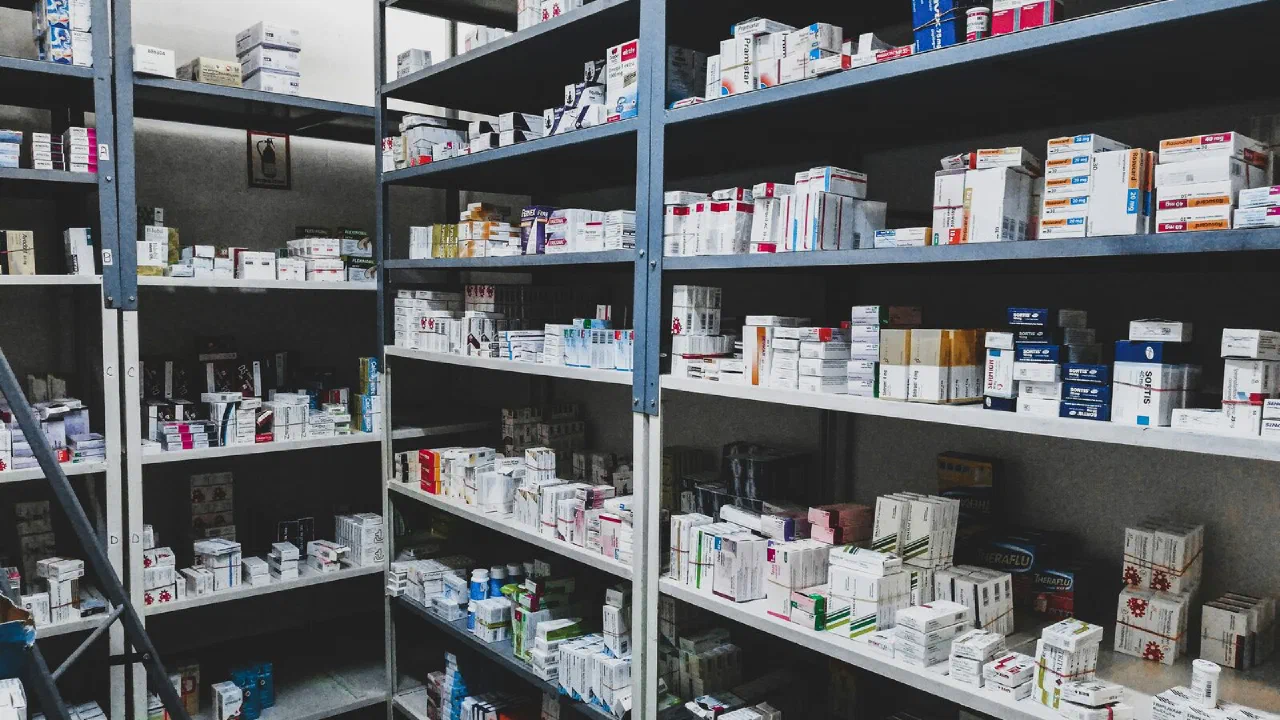
Find out whether your medication exists in Ecuador before you move, by its generic name, and find out while you still have a prescriber at home who can change it if it does not. That is the one piece of preparation on this page that cannot be done afterwards, and it is the one people skip.
Everything else about pharmacies here is easier than you expect and slightly different from what you are used to, and the difference is mostly vocabulary.
Checked 4 September 2026.
Generic names are the vocabulary
Brand names are national. The same molecule is sold under different names in different countries, and the name printed on the box in your bathroom at home may mean nothing at a counter in Cuenca. The generic name — the drug itself, not the manufacturer’s label for it — is international, and it is what will be recognised.
So the first job, before anything else:
- Write out every medication you take by its generic name, with the dose and the frequency.
- Put the brand name you know beside it, in brackets, for your own reference.
- Keep it on one page, in Spanish if you can, and carry a copy.
This list is the single most useful document a foreign resident carries here. It works at a pharmacy counter, at a consultation, and in an emergency department where you may not be the one answering questions — which is why the hospitals post says to carry it folded in the passport wallet.
The sentence at the counter is: "¿Tienen este medicamento, o un genérico equivalente?" — “Do you have this medicine, or an equivalent generic?” And if you want the cheaper version, which is usually available: "¿Cuál es la opción genérica más económica?"
What actually requires a prescription
Here is the practical shape, and it is different enough from the United States to be worth stating carefully.
Ecuador regulates prescription medicines. Controlled drugs — the categories you would expect, including psychotropics and opioids — are tightly controlled and are not obtainable casually, by anyone, and you should not arrive assuming otherwise. Antibiotics are prescription medicines and the rules on them have been tightened in recent years across the region.
At the same time, a great deal of routine medication that a foreigner might expect to need an appointment for is straightforward to obtain, and pharmacists here are accessible in a way that is genuinely useful — they will talk to you, at the counter, at no charge, about an ordinary problem.
What I am not going to do is print a list of what you can get without a prescription. That list is exactly the sort of thing that changes by regulation, varies in practice between pharmacies, and would be wrong within a year of writing. It is also the sort of claim that gets a reader into trouble rather than out of it. Ask a pharmacist about your specific medication. It is a two-minute conversation and it is current.
The one rule that does not move: if you take something regularly, get a local prescriber. Not because a pharmacy will necessarily refuse you once, but because a repeating supply with no local doctor behind it is a fragile arrangement, and the moment it fails is the moment you need it. Register with a general practitioner in your first month — the sequence for getting into the system is here — and if you are on IESS, the referral route is worth understanding early.
The drug that is not sold here
This is the real risk and it deserves the plain version.
Ecuador is a small pharmaceutical market. Not every medication licensed in the United States, Canada or the United Kingdom is registered and sold in Ecuador, and the ones most likely to be missing are the newest, the most specialised, and the ones for uncommon conditions. If your health depends on a specific recent drug, assume nothing.
What to do, in order, and all of it before you move:
- Check availability by generic name. The most reliable way is to ask a pharmacy in Cuenca directly — several will answer a written enquiry — or to ask a doctor here. Do this while you still have options.
- If it is not available, ask your prescriber at home what the alternative would be. This is a conversation to have with the person who knows your file, not with a website, and it is much easier to have before you have emigrated.
- If there is no acceptable alternative, treat that as a decision input about the move itself. That is a hard sentence and it is an honest one. It is also uncommon — but it is the scenario where the answer is genuinely don’t, and nobody who is paid by your relocation is going to say it to you.
- Do not plan around importing it personally. Bringing a personal supply for your own use is one thing; building an ongoing life around parcels of prescription medication crossing a border is a plan with a customs problem inside it, and I am not qualified to tell you how that goes.
I know two people who changed medication in advance because of this, on their own doctor’s advice, and both said the same thing: they were glad they had done it at home, with their own prescriber, rather than in month three here.
What it costs
Medication here is generally cheaper than in the United States and the gap is largest on generics — which is most of what you will be buying, once you are using generic names. That is the shape of it.
I am not printing prices, because they vary by pharmacy and by month and because you can get the current one by walking in and asking. But two things about the cost are structural and worth knowing:
- Ask for the generic explicitly. The branded and the generic version of the same molecule can differ substantially in price, and you will be handed whichever you ask for.
- Prices are not identical between pharmacies. Chains and independents differ, and for a regular monthly purchase the difference is worth ten minutes of comparison once.
Whether this comes out of your pocket or is covered depends on your route: IESS’s published description of the Seguro de Salud includes the provision of medicines as part of the coverage, read 4 September 2026, and what that means for a specific drug prescribed in a specific setting is a question to ask at the point of prescription rather than to infer from a sentence. The affiliation post covers what IESS is and is not good at.
The first-month list
If you are arriving, do these five things and the medication side of the move is essentially solved.
- Bring enough supply to cover the gap between landing and having a local prescriber — and make it generous, because the gap is longer than people plan for.
- Bring the one-page list by generic name, with doses.
- Bring a letter from your doctor summarising what you take and why, ideally in Spanish or with a translation.
- Register with a general practitioner in the first month, before you need one.
- Find your nearest pharmacy and one that opens late, and know which is which before a Sunday evening makes it urgent.
The wider first-week sequence has its own post, and the medication items above belong in it rather than being deferred to whenever settling-in feels finished.
Sources
- IESS, Seguro de Salud — the published description of coverage, which includes the provision of pharmaceutical supplies. Read 4 September 2026.
No drug names, prices, or lists of what is available without a prescription appear above. Those change by regulation and by pharmacy, they are quoted stale on most pages that carry them, and a pharmacist in Cuenca will answer the specific question about your specific medication in two minutes and be right on the day you ask.