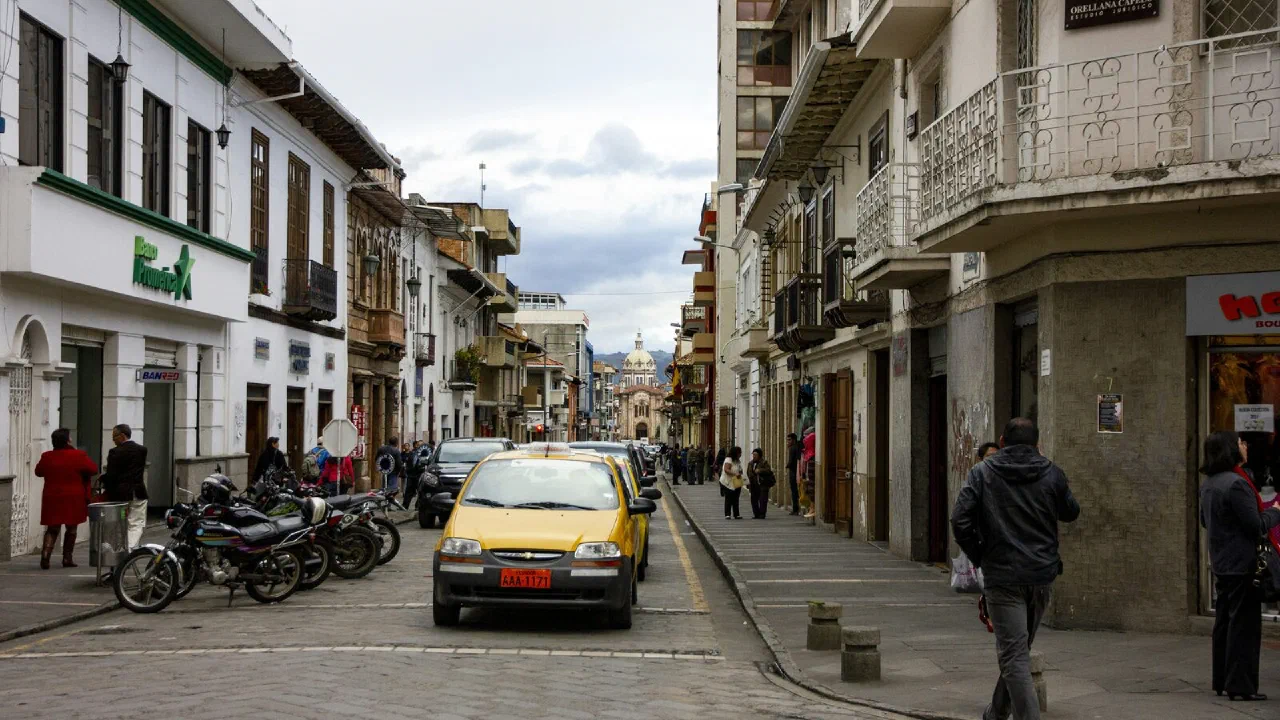
Renting an apartment in Cuenca, Ecuador goes wrong in writing, not in the viewing. The flat is almost never the problem. The problem is a one-page contract that says the rent and the term and nothing else, signed on the kitchen counter by two people who like each other, and which turns out — eleven months later, when you want your deposit back or the heater has failed or you have to leave early — to settle none of the four questions that were always going to come up.
So the call, before any of the reasoning: do not sign a lease here that does not name the deposit and how it comes back, the notice period on both sides, who pays the building fee, and who repairs what. Those four. If the landlord’s draft covers them, the rest is negotiable detail. If it covers none of them — and the common draft covers none of them — then you are not looking at a lease, you are looking at a receipt for the first month, and everything after that is going to be decided by whoever is more comfortable in the conversation. That will not be you in your first year.
This is the hub post for the whole subject. It covers what a lease here actually is, the clauses that cost foreigners money, the document list the landlord will ask for, what to put in writing before you sign, and the sentences to say at the table. The sums, the neighbourhoods and the search itself each get their own post, listed at the bottom.
Everything dated below was checked on 6 October 2026, and I have flagged every figure that moves.
What a Cuenca lease actually is, and why that matters more than the rent
Your tenancy sits under Ecuador’s Ley de Inquilinato whether or not either of you mentions it, whether or not anything is registered, and whether or not the contract is one page or twelve. That is the first thing worth knowing, because it cuts both ways.
It means the written contract is not the whole of your position — there is a statute behind it that a landlord cannot write out of existence with a sentence on a page. It also means the statute is not going to help you with the four questions above, because a statute settles the general case and your argument is going to be about a specific water heater, a specific month’s notice, and a specific deduction from a specific deposit. Those are evidence problems. Evidence is what the contract is for.
What the law gives you, what it withholds from an unregistered tenancy, and which remedy runs on what clock are precisely the questions to put to an abogada rather than to a blog — mine included. One consultation, before you sign your first lease rather than after, is the cheapest hour you will buy in your first year here, and I say that as someone who is generally against paying professionals to do things you can do yourself. This is not one of those things. The reason is simple: the contract is the only part of this arrangement you can still change, and you can only change it for about twenty minutes.
Two structural facts about the local market shape everything below.
The landlord is usually a person, not a company. Most flats in this city are owned by a family that owns one, two or four of them. There is no leasing department, no standard document, no deposit-holding scheme, and no process. That is better than it sounds — you can negotiate with a person — and worse than it sounds, because there is nobody above them to appeal to and no template protecting you from an omission.
Nothing is quoted in anything but dollars, because the currency is the dollar. Ecuador has been dollarised since 2000, and it means the thing it does not mean elsewhere: there is no exchange-rate risk in your rent and no exchange-rate cushion in it either. The number on the page is the number, for the whole term, and it is directly comparable to what you paid at home. That comparability is exactly why the next section exists.
The six clauses that cost foreigners money
Not the exotic ones. These six, in rough order of what they cost the people I have watched get caught by them.
1. The deposit, with no mechanism for its return
The custom in this city is one month’s rent held as a garantía, handed over with the first month, and that custom has held for the six years I have been renting here. What the custom does not include is any statement of how you get it back, when, or against what.
A deposit clause that is worth the ink says three things: the amount, the date it is returned by after you hand back the keys, and that deductions must be itemised in writing against a condition record made at move-in. Without the third, the deposit is simply the last month’s rent, collected a year early, and in practice a good share of foreigners never see it again and conclude that is how it works here. It is not how it works here. It is how it works when nothing was written down.
The deposit gets its own post, including the condition record, which is the single highest-value hour of unpaid work in this whole process.
2. Notice, written for one side only
Many drafts specify what the tenant must do to leave and are silent on the landlord. Some specify neither. A one-sided notice clause is not a trap being set; it is a draft written by someone who has only ever been the landlord. Fix it by symmetry — the same notice period, the same form, running both ways — and you will almost never meet resistance, because framed as symmetry it is obviously fair and framed as suspicion it is obviously rude.
Ask for the notice to be in writing and for in writing to include a message you can both show later. A conversation on the stairs is not notice, and you will not remember the date.
3. The building fee, unassigned
Any flat in a building with a lift, a gate, a guard, a shared tank or a swept lobby carries a monthly alícuota — the condominium charge. It is a real sum, it is not trivial relative to rent in the newer buildings, and about half of the drafts I have seen simply do not mention who pays it.
Ask the number and ask who pays it, and get both on the page. Ask also whether it is current — a building with arrears has a problem that becomes the resident’s problem via the water or the lift, not via the paperwork. The question in Spanish is
«¿Cuánto es la alícuota, quién la paga, y está al día el edificio?»
How much is the building fee, who pays it, and is the building paid up? Three answers, one sentence, and the pause before the third one tells you something.
4. Repairs, with no line between “yours” and “mine”
The default understanding here is roughly the sensible one — the structure, the installations and the appliances that came with the flat are the owner’s; what you break is yours — and the default understanding is worth nothing at 7pm on a Sunday when the water heater has stopped and the person who answers the phone would rather it be your problem.
So write the line. One sentence naming the water heater, the shower, the taps, the toilet cistern and anything electrical as the owner’s to repair, with a stated number of days to respond, converts a negotiation into a reminder. In a city where gas water heaters are common and the water is hard, the heater is the appliance this clause is actually about.
5. The rent review, left open
A twelve-month term with no statement about the rent is an invitation to a conversation in month eleven in which you have no position. You are the party with a flat full of furniture, a doctor nearby, and no desire to move; the other party knows it.
What you want is one sentence fixing the rent for the term, and — if you intend to stay, which most people do — one more putting a ceiling on the first renewal, in percentage terms rather than dollars. A percentage survives the year. A dollar figure agreed in 2026 is going to be argued about in 2027 on the grounds that everything has moved, and everything will have.
6. The term itself, written against you
The most expensive clause I have personally paid for. My second lease ran a year with a penalty for leaving early and no corresponding right to end it for cause, which I read, and agreed to, and did not think about again until the building next door started a construction project that ran eleven hours a day. Getting out cost me about a month and a half of rent — the penalty plus the overlap while I found somewhere else — and the whole of that was avoidable at signing with one sentence allowing either side to end the term on sixty days’ notice after month six.
I do not tell that story because it is unusual. I tell it because the clause that cost me is in nearly every draft, it looks completely unremarkable, and the sixty-day escape is almost never refused when you ask for it on the day. Nobody asks.
What the landlord will ask you for, in order
The document side is light here, and lighter than most arrivals expect. In the order it comes up:
- Identification. Your passport in week one. Once you have it, your cédula — and the cédula is what turns you from a stranger into a resident in this conversation, which is worth more than it should be. Getting it is its own appointment.
- A phone number that works locally, because everything after this runs on messages.
- The first month and the deposit, usually together, usually in cash or by local transfer. This is the part that catches people, and it catches them on the sequence rather than the amount: you need the money before you have a local bank account, and the ATM ceiling is daily. Ask whether you can pay across two or three days. The question is normal.
- Sometimes a guarantor or a reference. Less often for foreigners paying up front than the forum posts suggest, and where it comes up, the usual substitute offered is an extra month. Think about that before you agree: an extra month handed over with no return mechanism is clause 1 above, doubled.
What you will not generally be asked for is proof of income, a credit history, or anything from your home country. There is no central tenant record here. That cuts in your favour, and it is also why the landlord’s caution — when you meet it — is about you personally rather than about your file.
What to ask for, in writing, before you sign
The whole of the above, as a list you can hand over or read off a phone. This is the part of this post that is worth keeping.
- The monthly rent, fixed for the term, in dollars.
- The deposit: amount, the date it comes back by, and that deductions are itemised in writing against the move-in record.
- A dated condition record with photographs, signed by both of you, listing what is in the flat and its state. Attach it to the contract rather than keeping it separately.
- Meter readings on the day of handover — water and electricity both, written on the record. This is the clause that stops you paying for somebody else’s August.
- The alícuota: how much, who pays, and that the building is current.
- Repairs: the installations and appliances named as the owner’s, with days to respond.
- Notice: the same period both ways, in writing.
- An exit after month six on sixty days’ notice, for either side.
- What the rent may do at renewal, as a percentage ceiling.
- Both parties’ identification numbers on the document, and a copy each, signed. Not a photograph of a page — a counterpart you hold.
Ten items. None of them is adversarial, all of them are ordinary in a contract anywhere, and asking for all ten takes about twenty minutes at the table. I have never had a landlord refuse more than two.
The Spanish to say at the table
Not vocabulary. The actual lines, in the order you need them.
To open the subject without making it a confrontation:
«Me gusta el departamento. ¿Podemos revisar el contrato juntos antes de firmar?»
I like the flat. Can we go through the contract together before signing?
To ask for the four that matter:
«¿Puede constar en el contrato la garantía, el plazo del aviso, quién paga la alícuota y quién hace las reparaciones?»
Can the contract state the deposit, the notice period, who pays the building fee and who does the repairs?
To get the condition record, which is the one request people feel awkward making:
«Hagamos juntos un inventario con fotos el día de la entrega, firmado por los dos.»
Let’s make an inventory with photographs together on handover day, signed by both of us.
And the one sentence that has done more for me than any other, because it ends an argument before it starts and does so politely:
«¿Me lo puede poner por escrito, por favor?»
Could you put that in writing for me, please?
Say that one every time you are told something pleasant and unverifiable. It is not rude here. It is what you say.
What this post deliberately does not tell you
A number. You will notice there is no rent figure anywhere above, no deposit in dollars, no alícuota, and no penalty amount. That is on purpose and it is worth saying why, because nearly every page you will read on this subject leads with a monthly total.
Rents in this city vary by a factor of several across neighbourhoods, floors, furnishing and how the flat was found, and they are quoted to foreigners differently from how they are quoted to locals. That gap is a measurable thing with a mechanism behind it, and a single average hides it completely. A figure I paid in 2024 in one barrio is not information about what you will pay in 2027 in another; it is a number that will make you feel informed and then cost you money.
What travels is the ratio. Rent is the largest single line in a two-person month here by a wide margin — the itemised month puts it in order against everything else — and the deposit is one month of it. Those two statements will still be true in January, when every absolute on this site changes.
Where this leaves you
Sign nothing on the first viewing. Take the draft home, put the ten items against it, come back the next day with the gaps marked, and ask for them in the voice of someone tidying up an oversight rather than someone who has been warned. That is how it will be received, because in nearly every case it genuinely is an oversight.
Then do the handover properly — inventory, photographs, meter readings, both signatures — and keep a counterpart of everything in the same place you keep your visa folder. A year from now the only question that will matter is whether something was written down, and by then it is far too late to write it.
The rest of this part of the move, post by post
Finding a place here splits into four problems that barely touch each other: what it costs and why your price is not the local price, the paperwork around the contract, the search itself, and the day you take the keys. One at a time.
- The Foreigner Price on Rent, in Percentage Terms — Every page on the cost of housing in Ecuador quotes one range. Yours is different. How the foreigner price works in Cuenca, Ecuador, and how to measure it.
- The Unregistered Lease: Why the Landlord's Shortcut Becomes Your Problem — Ley de Inquilinato lease registration is a step most landlords in Cuenca, Ecuador skip. What you lose when they do, and the four things that replace it.
- Deposits in Cuenca: One Month, and Getting It Back — A rental deposit in Ecuador is one month's rent, held by your landlord with no scheme behind it. The half-hour in Cuenca, Ecuador that gets it back.
- Finding a Flat: The Facebook Groups, the Agencies, and Which Listings Are Real — Where affordable housing in Ecuador is really advertised, channel by channel, and the test that tells a live listing from a dead one in Cuenca, Ecuador.
- Utilities at Handover: ETAPA, Centrosur, and the Gas Cylinder — Search Ecuador gas prices and you get car fuel. What a tenant in Cuenca, Ecuador needs: the meter readings, the ETAPA and Centrosur accounts, and the cylinder.
- Furnished or Not: What the Word Means Here, and the Price Gap — A furnished apartment in Cuenca, Ecuador can mean a full kitchen or a bed and a table. What amoblado covers, what to confirm, and the break-even to work out.
Sources
- Ecuador’s Ley de Inquilinato is named above as the statute governing urban residential tenancy. Its provisions, and what they give an unregistered tenancy, are deliberately not summarised here — that is the question for an abogada, and the answer turns on particulars this post cannot see.
- Dollarisation since 2000, and its consequence that a rent quoted here carries no exchange-rate risk, as recorded on this site on 23 September 2026.
- Everything described as custom — the one-month deposit, cash or local transfer at signing, the rarity of income checks for a foreign tenant paying up front — is reported from six years of renting three flats in this city, observed rather than published, and checked against current practice on 6 October 2026. It is not a rule and nobody is bound by it.
No rent, deposit, alícuota or penalty figure appears above. Each one moves, each one varies by more than it would help you to know an average of, and each is readable from the actual listing in front of you on the day you need it.